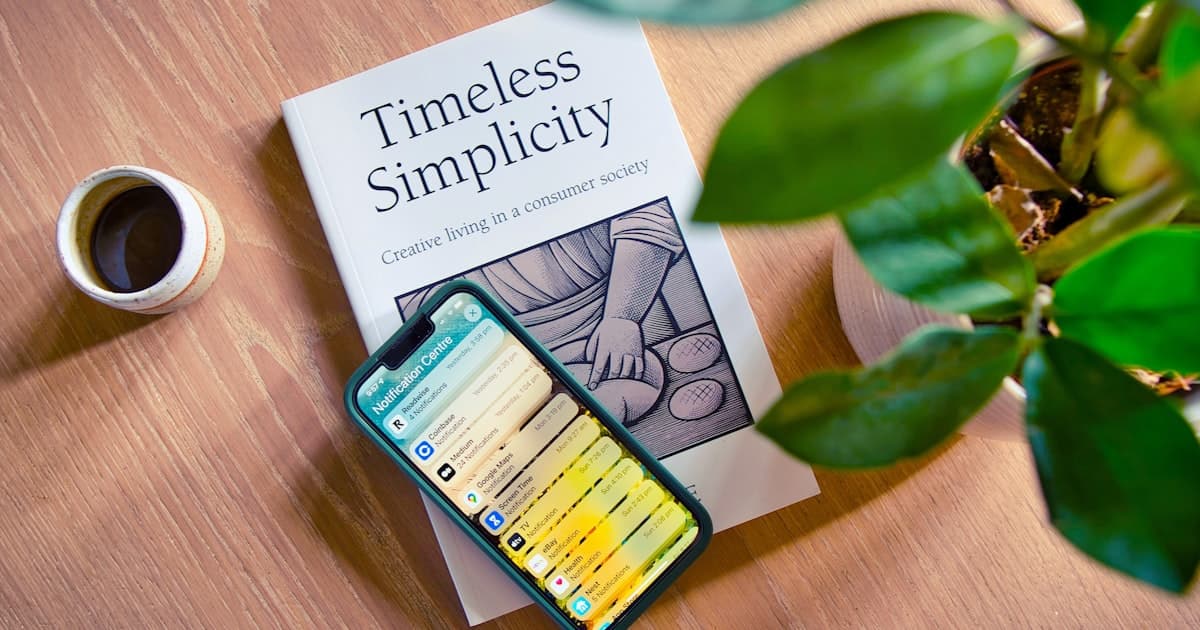
Every screen-time app starts from the same assumption: you can't be trusted. Set a limit. Lock the app. Block the feed. If you override it, you've failed.
We understand the impulse. When you're watching someone you love — or yourself — lose an hour to a feed they didn't mean to open, the instinct is to build a wall. Walls feel safe. They feel decisive. And for some people, in some moments, they work.
But for most people, most of the time, blocking fails. Not because the technology is bad. Because the model is wrong.
Why blocking doesn't work
The problem with blocking is that it treats every session the same. A two-minute check to see if your friend replied? Blocked. A twenty-minute scroll that quietly replaced the thing you meant to do? Also blocked — but only if you happened to set the right number in advance.
Blocking doesn't know the difference between intention and drift. It can't. It has one number and one rule.
So what happens? People override. They set the limit to 30 minutes, hit it, extend to 45, hit it, turn it off. The limit becomes a thing to negotiate with rather than a thing to trust. After a week, most people stop using the feature entirely.
How detection works
Threshold starts from a different place. Instead of asking 'how many minutes do you want?', it asks: 'what does your usual pattern look like?'
It watches — privately, on your device — how long you normally spend in each app. Not to judge. To learn. After a handful of sessions, it knows your typical stopping point. Not a number you picked. A number that emerged from your actual behavior.
Then, when a session runs past that point, Threshold does something no blocker does: it tells you.
That's it. A quiet signal. A moment of awareness. 'You've been here longer than usual.' Not 'you've been bad.' Not 'time's up.' Just: this session is different from your pattern. Do you want to keep going?
The drift problem
This is the core insight: most people don't need to be stopped. They need to be told. The drift isn't conscious. Nobody opens Instagram planning to spend 40 minutes. It happens in small increments — two more posts, one more reel, another reply — until the session is three times longer than intended and the feeling afterwards is familiar and heavy.
A blocker can't help with that. By the time the limit arrives, the drift has already happened. The damage is done.
A detector catches the drift while it's happening. In real time. Based on your pattern, not an arbitrary number.
Three levels of support
We built three levels because awareness isn't always enough. Some apps, some times of day, some moods — you want more than a quiet signal. So Threshold offers Guardrails (friction that makes continuing feel deliberate) and Hard Limits (actual enforcement when you want a firm stop). But even Hard Limits are different here: they're based on learned patterns, not guesses. We've written more about how to match the right intensity to the right moment.
The default is the gentlest level. You escalate when you want to. Not because the app decided you need it.
Why we chose a different story
There's a reason every competitor in this space leads with 'block distractions' or 'take back your time.' It's the easiest story to tell. It sounds decisive. It sounds like control.
But control that depends on willpower at the moment of weakness isn't control. It's a trap. You set the limit when you're calm and rational. You hit it when you're not. And then you override it, and feel worse.
Detection respects the difference. It doesn't ask you to predict the future. It meets you where you are and gives you information. What you do with that information is up to you.
Who Threshold is for
We know this approach isn't for everyone. Some people genuinely want a lock on their phone. Some people want to hand the key to someone else. Those products exist, and they're good at what they do.
Threshold is for the people who don't want to be locked out of their own phone. Who don't want to fight with a timer every evening. Who just want to know, in real time, when a session is starting to look different from what they intended.
That's a smaller promise than 'reclaim your life' or 'save two hours a day.' But it's an honest one. And we think, for the right person, it's the one that actually sticks. If you're looking for practical strategies to pair with this approach, we've put together a guide to reducing screen time on iPhone.